
On this page
What can be repaired?
Most single faults. A leaking joint, a loose run, a crushed downspout, a short section of rotten fascia or a gutter knocked down by a limb can all be fixed without touching the rest of the system.
| Problem | Usual cause in north Fulton | Typical fix | Page |
|---|---|---|---|
| Drip at a corner or end | Sealant split by heat and movement | Scrape out, clean, reseal | Leaking gutters |
| Run tipping forward or pulling off | Spikes backing out, wet needles, soft fascia | Re-hang on screw-in hangers | Sagging gutters |
| Water pouring over the front | Plugged outlet or undersized gutter | Clear, add outlet, or upsize | Overflowing gutters |
| Downspout leaking or crushed | Mower strike, loose straps, silted buried line | Replace section, re-strap, clear line | Downspout repair |
| Stained or soft board behind gutter | Water running behind a short drip edge | Replace fascia, add apron | Fascia and soffit |
| Dented, bent or torn run | Limbs, hail, ladders | Replace the section | Storm and hail damage |
How does a gutter repair visit go?
- Watch the water. Where possible the contractor runs a hose so the leak or spill shows itself, rather than guessing from stains.
- Clean the area. Needles and grit are cleared so joints, outlets and hangers can be seen.
- Check the line. A level along the run shows sags and backward pitch that hold water.
- Test the fascia. The board is probed at every corner and along any stained stretch.
- Fix the cause. Reseal, re-hang, replace a section or swap a downspout, depending on what was found.
- Re-test. Water goes through again to prove the fix before the ladder comes down.
- Explain what is next. A good contractor tells you whether the rest of the system has years left or is close behind.
Why do gutters fail around Alpharetta?
Age. Alpharetta's population climbed from 3,128 in 1980 to 34,854 by 2000, so a large share of local homes went up in the 1980s and 1990s. Gutters from that era are now thirty to forty years old. Many were hung with spike and ferrule, which works loose as the wood around it dries and swells.
Heat cycles. Aluminum grows and shrinks every sunny day. Over many summers that movement splits sealant at corners and end caps and pulls spikes out of the fascia.
Debris weight. A gutter full of wet pine straw and oak leaves is heavy, and the weight sits on hangers that may already be loose.
Storms and limbs. Summer squall lines and tropical remnants bring down branches. In late August 2024 severe storms crossed Roswell and Alpharetta with hail and damaging gusts, and a hail report that week at Haynes Bridge Road and Westside Parkway logged stones about 1.25 inches across.
Water behind the gutter. Many tract houses were built with a short drip edge or none. Water then runs down the back of the gutter, rots the fascia and loosens every fixing in it.
When is replacement better than repair?
| Sign | Repair | Replace |
|---|---|---|
| Leaks | One or two joints | Most joints, or old sectional gutter |
| Sagging | One stretch with sound fascia | Long lengths, with rot behind |
| Rust | None (aluminum does not rust) | Galvanized steel rusting through |
| Size | Spills only when outlets clog | Spills in every hard rain even when clean |
| Age | Under about twenty years | Thirty years or more, spiked, many patches |
The guide repair or replace your gutters goes through the decision.
What does a gutter repair cost?
Repairs are usually priced per visit or per item rather than per foot: resealing a few joints, re-hanging a run, swapping a downspout. Fascia replacement is typically charged per foot of board. No published source gives Alpharetta repair prices, so ask the contractor to list each item separately in writing.
Can I fix my own gutters?
Cleaning a single-storey gutter from a well-footed ladder is a reasonable job for many people. Resealing joints is too, on a dry day. Re-hanging long runs, replacing fascia and anything on a second storey are better left to someone with the right ladders and stand-offs. Ladder falls are a common cause of injury at home, so if you go up, keep three points of contact and never reach out past the rails.
Sheets of water jumping the gutter in a summer storm
North Fulton thunderstorms can drop more rain in twenty minutes than a 5-inch gutter with one downspout can move. If the outlet is clear and the run is level, the system is undersized: a 6-inch trough, a 3x4 downspout or an extra drop fixes it. If the outlet is packed with pine straw, start there. See overflowing gutters.
Pine needles and sweetgum balls in the trough
Loblolly pines shed needles through the year and heaviest in fall. Sweetgum seed balls roll down the roof and lodge at outlets like corks. A fine mesh guard stops both; open screens catch needles and hold them. See pine trees and gutters.
A drip at an inside corner or end cap
The sealant in that joint has split. Georgia sun bakes it in summer and the joint flexes every time the metal heats and cools. The old bead is scraped out and a new one laid on clean, dry metal. See leaking gutters.
The gutter is tilting forward or pulling off the house
Spikes have backed out, hangers are too far apart, or the fascia behind has gone soft. A trough full of wet needles is heavy. The bad wood comes out, then the run is re-hung on screw-in hangers. See sagging gutters and fascia and soffit.
A limb came down or a storm bent the run
Hardwoods and pines drop limbs in tropical-storm wind and summer squall lines. Kinked lengths are swapped rather than hammered straight. The storm damage page lists what to photograph first.
Red clay washing out or a wet basement wall
A downspout is dumping beside the foundation, or a buried pipe has filled with silt. Piedmont clay sheds water across its surface and erodes where a downspout lands. See downspout repair and drainage and your foundation.
Repair terms
| Term | Plain meaning |
|---|---|
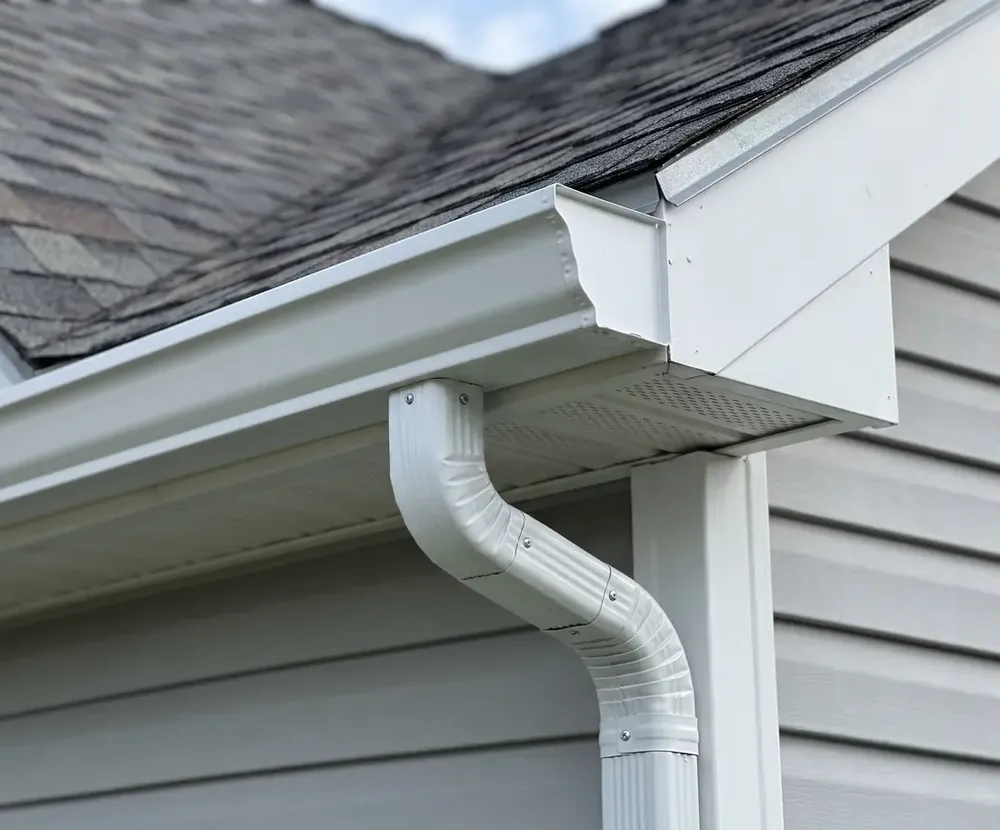
| Sealant | The flexible gutter sealant laid in every seam and around every outlet |
| Spike and ferrule | A long nail driven through the gutter face and a metal tube, the fixing used on many 1980s and 1990s houses here |
| Hidden hanger | A clip that sits inside the gutter under the front lip and screws through the back into the fascia |
| Strip miter | A corner made by cutting two runs at an angle and bridging them with a riveted strip |
| Box miter | A factory corner piece both runs fit into, which leaves two seams instead of one |
| End cap | The plate that closes off the open end of a run |
| Outlet | The opening in the gutter floor with a short sleeve that feeds the downspout. Also called a drop |
| Fascia | The vertical board across the rafter ends. Every hanger is screwed into it |
| Drip edge | Bent metal trim along the roof edge, tucked under the bottom shingles, that steers runoff into the trough instead of onto the board |
| Gutter apron | A wider flashing that runs up under the shingles and hangs down inside the back of the gutter to close the gap |
| Cleanout | A cap or removable fitting where a downspout joins a buried line, so debris can be pulled out |