
On this page
- What commercial gutter work is common around Alpharetta?
- How is a commercial gutter job planned?
- What matters for commercial buildings in this climate?
- Which metals suit commercial gutters?
- Who does commercial gutter work?
- What does commercial gutter work cost?
- How do maintenance contracts work?
- What about churches and schools?
- Commercial gutter terms
What commercial gutter work is common around Alpharetta?
Box gutters on metal-roofed buildings, oversized K-style on apartment and townhouse buildings, scuppers and collector heads on flat-roofed offices, and replacement of downspouts damaged by vehicles and equipment.
| Building type | Typical system | Usual issues |
|---|---|---|
| Flat-roof office or retail | Scuppers, collector heads, large rectangular leaders | Clogged scuppers, leaking collector heads, crushed leaders |
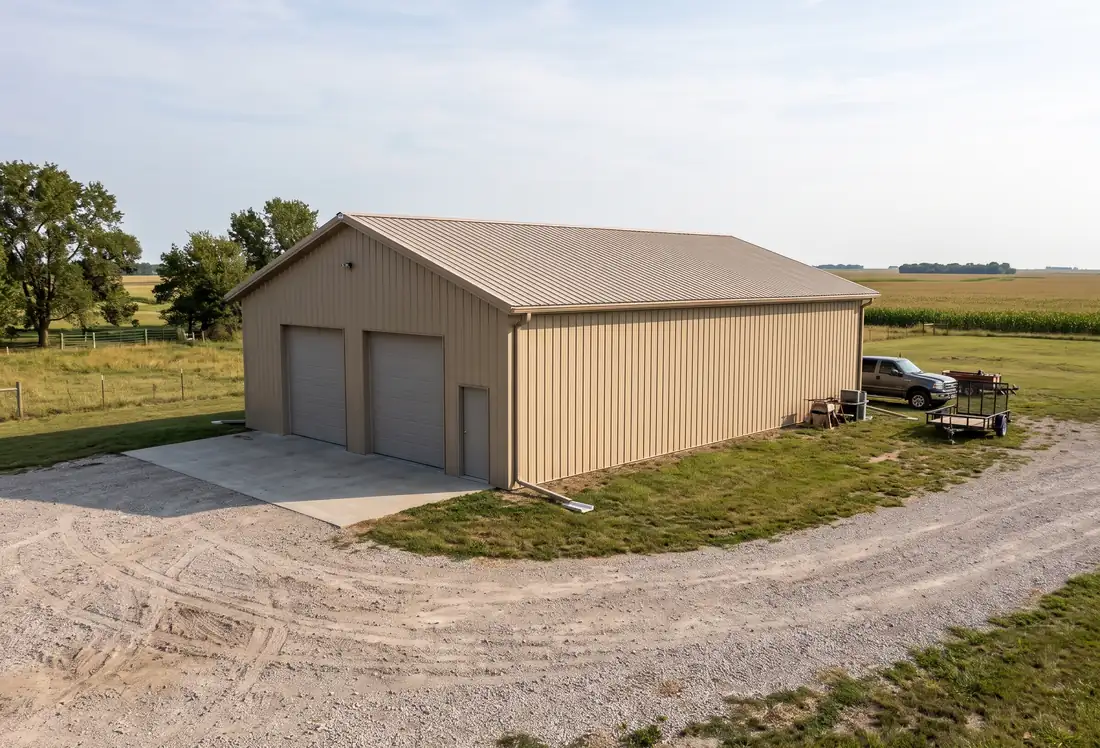
| Metal-roof warehouse or workshop | Box gutter, 6-inch or larger, heavy brackets | Expansion joint failure, overflow at valleys |
| Apartment and townhouse buildings | 6-inch K-style, 3x4 downspouts | Long runs, many outlets, debris from landscaping trees |
| Churches and schools | Mix of K-style, half-round and box gutters | Tall walls, steep roofs, access |
| Restaurants and strip centers | K-style or box gutter over walkways | Water dripping on customers, grease and debris near kitchens |
How is a commercial gutter job planned?
- Survey the roof and drainage. Roof areas, slopes, valleys, scuppers and existing downspouts are measured, and the building's storm drain connections are located.
- Size for the roof area. Large roofs need gutters and leaders sized to carry the volume from a heavy storm, not just to fit the eave.
- Choose the metal. Heavier aluminum, galvanized or Galvalume steel and sometimes copper, depending on the building and the look required.
- Plan access and safety. Lifts, roof anchors and traffic control around customers and tenants are arranged before work starts.
- Fabricate. Box gutters and collector heads are often shop-made to size; seamless K-style can be formed on site.
- Install with expansion joints. Long runs need joints that let the metal move with temperature.
- Connect to drainage. Leaders tie into storm lines, with cleanouts at the base.
- Test and document. Water is run through, and the work is documented for the property manager.
What matters for commercial buildings in this climate?
Volume. A large flat or low-slope roof collects a lot of water in a summer storm. When Hurricane Helene dropped 11.12 inches on Atlanta in 48 hours, it was drainage capacity, not gutter appearance, that mattered.
Temperature swings. Long metal gutters on sunny commercial roofs move a lot between morning and afternoon. Without expansion joints they buckle or tear at their fixings.
Landscape trees. Office parks and apartment communities are planted with oaks, maples, crape myrtles and pines. Leaves and needles collect in gutters and scuppers, so maintenance contracts are common.
Stormwater rules. Leaders on commercial sites usually connect to engineered storm systems. Alpharetta's public works department has reminded property owners that storm drains are for water only, and anything else entering them counts as an illicit discharge.
Which metals suit commercial gutters?
| Metal | Strengths | Watch for |
|---|---|---|
| Heavy-gauge aluminum | Light, does not rust, many colors | Dents from equipment and ladders |
| Galvanized or Galvalume steel | Strong, suits box gutters and metal roofs | Rust at cut edges and scratches over time |
| Copper | Very long life, prestige look | High cost; never fasten with steel |
| Stainless steel | Durable in demanding settings | Cost and fabrication time |
Who does commercial gutter work?
Some residential gutter contractors also take light commercial jobs such as apartment buildings and small retail. Larger box gutter and scupper work is often handled by sheet metal or commercial roofing firms. When you call, describe the building, roof type and size so the right contractor comes out. Ask for insurance certificates and confirm who handles permits and lift rental.
What does commercial gutter work cost?
Too variable to give a useful range: it depends on the building height, access, metal, fabrication and drainage connections. Ask for a written proposal that lists every item and the schedule.
How do maintenance contracts work?
Many property managers book cleanings and inspections on a schedule, for example spring and late fall, with extra visits after major storms. A good contract lists what is checked each visit: gutters, scuppers, collector heads, downspouts, buried connections and any guards, with photos of problems found. That record helps plan repairs before they turn into leaks inside the building.
| Visit | Focus |
|---|---|
| Spring | Pollen and seed debris, storm-season readiness |
| Late fall | Leaf and needle removal, outlet checks |
| After major storms | Damage, blockages, scuppers on flat roofs |
What about churches and schools?
Churches and schools often have steep roofs, tall walls, bell towers and older materials such as copper or half-round. Work around them is planned for times when the building is empty, and access often needs a lift. A good contractor will also look at how runoff reaches walkways, since water dripping on entrances is a safety issue.
Commercial gutter terms
| Term | Plain meaning |
|---|---|
| Box gutter | A deep square-section gutter, usually steel, used on commercial buildings and some custom homes |
| Scupper | An opening in a parapet wall that drains a flat or low-slope roof into a collector head |
| Collector head | A box at the top of a downspout that receives water from a scupper or from two gutters at once |
| Expansion joint | A slip joint in a very long run that lets the metal grow and shrink without tearing |
| Downspout | The pipe that carries water from the outlet to the ground. Some people call it a leader |
| Cleanout | A cap or removable fitting where a downspout joins a buried line, so debris can be pulled out |
| Gauge | Metal thickness. Residential aluminum comes in 0.027 or 0.032 inch; copper is sold by weight, 16 or 20 ounce |
| Bracket | An external support the gutter rests in, screwed to the fascia below. Normal for half-round |
| Buried drain line | Solid pipe under the lawn taking downspout water to daylight, a pop-up emitter or a street-side outfall |