
On this page
What goes wrong with downspouts?
They clog, they get crushed, they come loose from the wall, and the buried lines they feed fill with silt or roots. Each failure sends water back up into the gutter or out at the base of the wall.
| Problem | Signs | Fix |
|---|---|---|
| Clog at the top elbow | Gutter spills near the outlet, downspout dry | Clear from the top, flush |
| Clog in a buried line | Water backs up at the cleanout or bursts the joint | Snake or jet the line, check the outlet |
| Crushed section | Bent or flattened pipe near the ground | Replace the section |
| Loose or missing straps | Downspout leaning or swinging | Re-strap |
| Separated joints | Water spraying from a joint | Re-fit with the upper piece inside the lower |
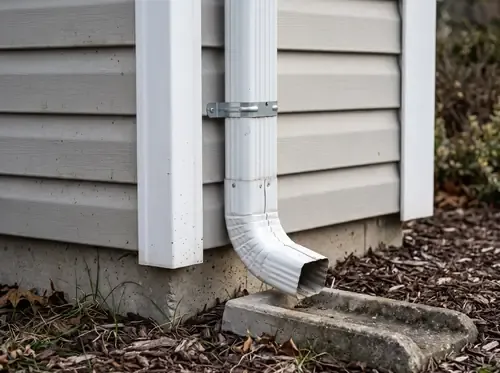
| Short discharge | Puddles or erosion by the wall | Add extension, splash block or buried line |
How is a downspout repaired?
- Find the blockage. Water from a hose at the outlet shows where it stops. Tapping the pipe often finds the packed spot.
- Clear it. Debris is pulled from the top, pushed through with a plumber's snake or flushed out; removing the bottom elbow helps.
- Check buried lines. Water should come out at the pop-up emitter or daylight outlet. If not, the line is snaked, jetted or dug up.
- Replace damaged pipe. Crushed or split sections and elbows are replaced with matching size and color.
- Re-strap. Straps go back at the top, bottom and every 6 to 10 feet.
- Fix the discharge. An extension, splash block or buried line carries water away from the wall.
- Test. Water runs through to prove it.
Why do downspouts fail around Alpharetta?
Pine straw and sweetgum balls. Needles and seed balls lodge in the top elbow, especially on 2x3 downspouts. Switching to 3x4 helps a lot.
Lawn equipment. Mowers, string trimmers and cars crush the lower sections. Hinged extensions that flip up for mowing reduce strikes.
Buried lines in clay. Silt from red clay soils washes into buried pipe and settles. Roots find their way into joints. Lines laid without enough slope fill up.
Storms. Heavy rain shows up every weak point at once. During Helene's record rain in September 2024, downspouts that were partly blocked could not keep up.
Why does it matter where a downspout ends?
The red clay subsoil of the Piedmont takes in water slowly. A downspout that empties at the wall saturates the backfill against a basement or crawl-space wall. One that empties onto bare clay cuts a channel and carries soil away. Carrying the water 4 to 10 feet out, onto ground that slopes away, protects both the foundation and the yard. See downspout drainage and your foundation.
Should a blocked buried line be replaced?
| Condition | Option |
|---|---|
| Line clogs at a known spot, pipe sound | Clear and add a cleanout |
| Corrugated pipe crushed or full of silt | Replace with smooth solid pipe |
| No outlet at the far end | Add a pop-up emitter or run to daylight |
| Line slopes back toward the house | Re-lay with proper fall |
| Roots through the joints | Clear, then replace the section |
What does downspout repair cost?
It depends on what is wrong: clearing a top elbow is a quick job, replacing a crushed section is modest, and digging up a buried line is more. Ask for each item separately in writing.
Downspout repair terms
| Term | Plain meaning |
|---|---|
| Downspout | The pipe that carries water from the outlet to the ground. Some people call it a leader |
| Elbow | A bent downspout fitting. A-style turns out from the wall or back to it; B-style turns sideways along it |
| Strap | The metal band that holds a downspout to the siding or brick |
| Outlet | The opening in the gutter floor with a short sleeve that feeds the downspout. Also called a drop |
| Cleanout | A cap or removable fitting where a downspout joins a buried line, so debris can be pulled out |
| Buried drain line | Solid pipe under the lawn taking downspout water to daylight, a pop-up emitter or a street-side outfall |
| Pop-up emitter | A cap at the end of a buried line that lifts under water pressure to let it out onto the lawn |
| Splash block | A ribbed concrete or plastic tray under the downspout that breaks the stream before it digs into clay |
| Extension | A length of downspout or flexible pipe added at the foot to carry water farther out |