
On this page
- What gutters do most Alpharetta houses get?
- How is a new gutter system put up?
- What does north Fulton weather ask of a gutter?
- What size gutter does my house need?
- What does gutter installation cost?
- What should a gutter quote include?
- Does a gutter installer need a Georgia license?
- When is the best time of year to install?
- Parts of a gutter system
What gutters do most Alpharetta houses get?
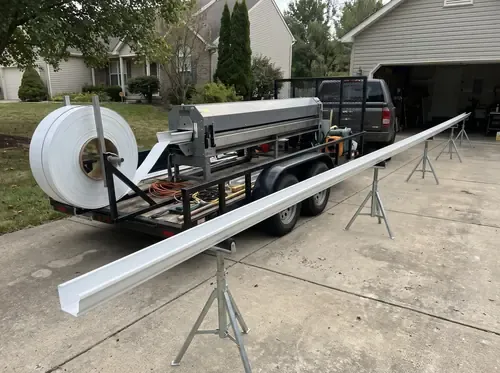
Seamless aluminum in the K-style profile, 5 or 6 inches across, with rectangular downspouts. The installer arrives with painted coil and a forming machine and makes every run to the length of the wall it hangs on.
| Decision | Common choice here | When something else makes sense |
|---|---|---|
| Profile | K-style | Older houses near downtown and some custom homes look right in half-round |
| Width | 6-inch on most two-storey homes | A small single-storey ranch can manage with 5-inch; steep roofs and valleys need 6-inch |
| Metal | Aluminum, 0.032 inch | Period or high-end custom homes sometimes take copper |
| Seams | Seamless | A detached shed or pool house the truck cannot reach |
| Downspouts | 3x4 on 6-inch, 2x3 or 3x4 on 5-inch | Under heavy pine cover, 3x4 everywhere. See downspouts |
How is a new gutter system put up?
- Measure and plan the outlets. Each eave is measured and outlets are placed where water can be carried away from the foundation, not dumped on a slope that drains back toward the basement.
- Probe the fascia. The board is checked end to end with an awl. Rot hides behind old gutters, especially at corners, and soft wood is replaced before anything is hung.
- Check the roof edge. Where drip edge is missing or short, a gutter apron is slid under the shingles so water cannot track down behind the trough.
- Form the runs. Coil feeds through the machine and each length comes out cut to the wall.
- Prepare outlets and ends on the ground. Outlets are cut and sealed and end caps crimped and sealed before the run goes up.
- Hang the run. Screw-in hidden hangers go in no more than about two feet apart, along a line that falls roughly a quarter inch every ten feet.
- Make the corners. Miters are cut, riveted and sealed on the inside.
- Add the downspouts. Pipe and elbows are strapped to the wall and led to an extension, a splash block or a buried line.
- Test with water. A hose at the high end of each run should show water reaching every outlet with nothing left standing.
What does north Fulton weather ask of a gutter?
Short, heavy storms. Alpharetta averages about 51 inches a year, but the total is not the problem. Summer thunderstorms can drop an inch or more in under an hour, and that peak is what a gutter and its downspouts have to carry. Undersized systems spill over the front lip even when they are perfectly clean.
Tropical rain. Storms that come ashore on the Gulf often reach north Georgia as long soaking rains. When Hurricane Helene passed in September 2024, Atlanta recorded 11.12 inches in 48 hours, the most for any 48-hour stretch since 1878. A system that copes with that needs clear outlets and enough downspouts.
Pines and hardwoods. Loblolly pines shed needles all year, oaks and tulip poplars drop leaves through late fall, and sweetgum balls roll down roofs and plug outlets. See pine trees and gutters.
Red clay. The Cecil soils of the Piedmont have a red clay subsoil that takes water in slowly. A downspout that empties against the house can saturate backfill around a basement wall, and one that empties onto bare clay cuts a gully. See downspout drainage and your foundation.
Heat. Long summer days bake sealant and make aluminum expand and contract every afternoon. Good sealant and fewer joints last longer.
What size gutter does my house need?
| House type | Gutter | Downspouts |
|---|---|---|
| Single-storey ranch, simple hip or gable roof | 5-inch K-style | 2x3, one for every 30 to 40 feet |
| Two-storey traditional, front gable, rear deck | 6-inch K-style | 3x4 at each corner and beside valleys |
| Large home with many roof planes | 6-inch, valley diverters | 3x4, often tied to buried lines |
| Basement house on a sloping lot | 6-inch on the tall downhill wall | 3x4 led well away from the foundation |
| Older house with open eaves near downtown | 6-inch half-round on brackets | 3 or 4-inch round |
| Detached garage or workshop with metal roof | 6-inch or box gutter | 3x4 or larger |
Read 5-inch vs 6-inch gutters for the detail.
What does gutter installation cost?
National price guides from Angi and This Old House put installed 5-inch seamless aluminum at roughly $9 to $14 a foot and 6-inch at about $11 to $17. Nobody publishes a separate north Fulton figure, so read those as national ranges, not a local quote. Two-storey walls, a lot of inside corners, fascia replacement, guards and buried drain lines all add to the figure. The Alpharetta cost guide works through typical houses.
What should a gutter quote include?
- Proof of liability insurance, and any city business license the contractor holds
- Total feet of gutter and the number of downspouts
- Profile, width, metal and gauge
- Gutter and downspout colors
- Hanger type and spacing
- How corners are made
- Where each downspout will empty, and whether buried lines are included
- Removal and disposal of old gutters
- Any fascia or soffit repair, and the rate per foot if more is found
- Guards, if any, by type and brand
- Total price and when payment is due
Does a gutter installer need a Georgia license?
Not a state residential or general contractor license, if gutters and downspouts are the whole job. Georgia's licensing board treats gutters and downspouts as a traditional specialty, and specialty contractors working within their trade do not need that license, though their work must still meet codes. Ask for an insurance certificate and check whether your city wants a business license or permit.
When is the best time of year to install?
Spring and fall are easiest: dry spells are common, sealant cures well and crews are not fighting summer heat on a ladder. Late summer fills up once the first tropical remnants show which gutters cannot keep up.
Parts of a gutter system
| Term | Plain meaning |
|---|---|
| K-style | The standard residential profile with a flat back and a curved, crown-molding front. Also sold as ogee |
| Half-round | An open semicircle gutter hung in brackets, used on older and period-style houses |
| Coil | The roll of prepainted aluminum or steel that a seamless machine forms into gutter in the driveway |
| Fascia | The vertical board across the rafter ends. Every hanger is screwed into it |
| Drip edge | Bent metal trim along the roof edge, tucked under the bottom shingles, that steers runoff into the trough instead of onto the board |
| Gutter apron | A wider flashing that runs up under the shingles and hangs down inside the back of the gutter to close the gap |
| Hidden hanger | A clip that sits inside the gutter under the front lip and screws through the back into the fascia |
| Hand-cut miter | A corner folded and cut from the gutter itself on site, riveted and sealed with a single seam |
| End cap | The plate that closes off the open end of a run |
| Outlet | The opening in the gutter floor with a short sleeve that feeds the downspout. Also called a drop |
| Elbow | A bent downspout fitting. A-style turns out from the wall or back to it; B-style turns sideways along it |
| Downspout | The pipe that carries water from the outlet to the ground. Some people call it a leader |
| Strap | The metal band that holds a downspout to the siding or brick |
| Buried drain line | Solid pipe under the lawn taking downspout water to daylight, a pop-up emitter or a street-side outfall |
| Fall | The pitch of a run toward its outlet, usually about a quarter inch for every ten feet |