
On this page
- What is a seamless gutter?
- How are seamless gutters made and hung?
- Why do seamless gutters suit Alpharetta houses?
- What sizes and metals are available?
- What do seamless gutters cost?
- Are seamless gutters really leak-free?
- Can a seamless gutter be too long?
- Seamless or sectional for a shed or carport?
- Seamless gutter terms
What is a seamless gutter?
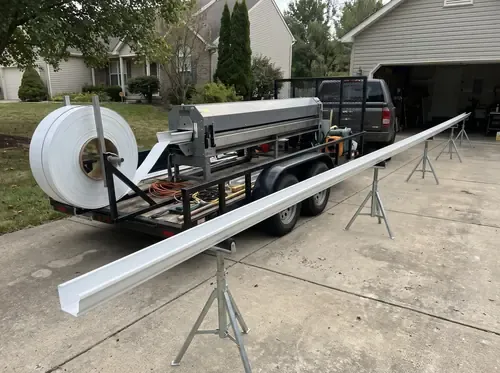
A gutter run made in one continuous piece for each wall, instead of being joined from 10-foot store-bought sections. The contractor feeds flat coil through a portable roll-former, which bends it into the K-style or other profile and pushes it out until it reaches the length of the eave. The run is cut, carried to the house and hung in one piece.
| Feature | Seamless | Sectional |
|---|---|---|
| Joints on a 40-foot wall | None along the run | Three or four |
| Where leaks start | Corners and outlets only | Every seam plus corners and outlets |
| Made | On site, to the inch | Bought in stock lengths |
| Usual metal | Aluminum, sometimes steel or copper | Vinyl, aluminum or steel |
| Look | Clean line along the fascia | Visible seams every 10 feet |
| DIY friendly | No, needs the machine | Yes |
How are seamless gutters made and hung?
- Measure every eave. Lengths are taken corner to corner, and outlets are marked where downspouts can drain away from the house.
- Set up the machine. The roll-former sits on a trailer or truck bed in the driveway with the chosen coil color loaded.
- Form each run. Coil runs through the rollers and comes out as finished gutter, cut a little long for trimming.
- Cut outlets and fit end caps. Outlets are cut and sealed, and end caps crimped on, before the run leaves the ground.
- Carry and lift. Long runs are carried by two or three people and lifted to the eave without kinking.
- Hang on hidden hangers. Screw-in hangers go in about every two feet, with a steady fall toward each outlet.
- Join corners. Miters are cut, riveted and sealed inside.
- Fit downspouts. Pipe, elbows and straps are added and led to extensions, splash blocks or buried lines.
- Test. Water is run from the high end to check flow and seams.
Why do seamless gutters suit Alpharetta houses?
Heat. Long, hot summers make metal expand and contract every day, and each seam is a place where that movement eventually cracks sealant. Fewer seams means fewer leaks.
Long walls. Many two-storey traditionals and large custom homes in north Fulton have rear walls of 40 to 60 feet. A sectional gutter on that wall has five or six joints; a seamless one has none until the corner.
Heavy rain. Summer storms fill gutters quickly. Seams that weep slightly in a light rain can stream in a cloudburst.
Looks. In neighborhoods with strict HOA review, a clean seamless line in a matching color fits the house better than visible joints.
What sizes and metals are available?
| Option | Common choices | Notes |
|---|---|---|
| Profile | K-style; half-round from some installers | K-style is standard; half-round needs a different machine |
| Width | 5-inch and 6-inch | 6-inch is common on two-storey homes here |
| Aluminum gauge | 0.027 and 0.032 inch | 0.032 holds up better under pines and ladders |
| Other metals | Galvanized or Galvalume steel, copper | Copper seamless is available from some shops |
| Colors | Dozens of baked-enamel colors | Match fascia, trim or roof; check HOA rules |
What do seamless gutters cost?
National guides from Angi and This Old House put seamless aluminum at roughly $9 to $14 per installed foot for 5-inch and $11 to $17 for 6-inch. Those are national ranges; no local Alpharetta figure is published. Two-storey height, inside corners, fascia repair, extra downspouts, buried drain lines and guards all raise the total. See the Alpharetta cost guide.
Are seamless gutters really leak-free?
No gutter is. Seamless gutters still have corners, end caps and outlets, and those are sealed joints that age. What seamless removes is the joint every 10 feet along the run, which is where sectional gutters most often drip. Good sealant, well-made corners and correct pitch matter as much as the lack of seams. See leaking gutters.
Can a seamless gutter be too long?
Very long runs move more with temperature. On runs over about 40 feet, installers often put the outlet near the middle or fit downspouts at both ends so water does not have to travel the whole length, and on very long commercial runs they add an expansion joint.
Seamless or sectional for a shed or carport?
Where the truck cannot reach, or for a short run on an outbuilding, a sectional gutter can be the practical choice. For the house itself, seamless is the norm. Read seamless vs sectional gutters.
Seamless gutter terms
| Term | Plain meaning |
|---|---|
| Coil | The roll of prepainted aluminum or steel that a seamless machine forms into gutter in the driveway |
| K-style | The standard residential profile with a flat back and a curved, crown-molding front. Also sold as ogee |
| Gauge | Metal thickness. Residential aluminum comes in 0.027 or 0.032 inch; copper is sold by weight, 16 or 20 ounce |
| Hidden hanger | A clip that sits inside the gutter under the front lip and screws through the back into the fascia |
| Hand-cut miter | A corner folded and cut from the gutter itself on site, riveted and sealed with a single seam |
| Box miter | A factory corner piece both runs fit into, which leaves two seams instead of one |
| End cap | The plate that closes off the open end of a run |
| Outlet | The opening in the gutter floor with a short sleeve that feeds the downspout. Also called a drop |
| Expansion joint | A slip joint in a very long run that lets the metal grow and shrink without tearing |
| Fall | The pitch of a run toward its outlet, usually about a quarter inch for every ten feet |