
On this page
What size downspouts do I need?
Most houses here use 2x3-inch downspouts on 5-inch gutters and 3x4-inch on 6-inch gutters. A 3x4 downspout carries roughly twice what a 2x3 carries and clogs far less under pines, so many contractors fit 3x4 everywhere on two-storey homes.
| Downspout | Pairs with | Use |
|---|---|---|
| 2x3 inch rectangular | 5-inch K-style | Small roofs, light tree cover |
| 3x4 inch rectangular | 6-inch K-style, or 5-inch under trees | Most two-storey homes and below valleys |
| 3-inch round | 5-inch half-round | Period homes |
| 4-inch round | 6-inch half-round | Larger half-round systems |
| 4x5 or larger | Box gutters | Commercial roofs |
How many downspouts does a house need?
One for roughly every 30 to 40 feet of gutter as a starting point, and more on steep or large roofs. Any run longer than about 40 feet is better with an outlet at each end or in the middle. A valley that dumps into the gutter usually needs a downspout close by.
Where should a downspout drain?
| Option | How it works | Best for |
|---|---|---|
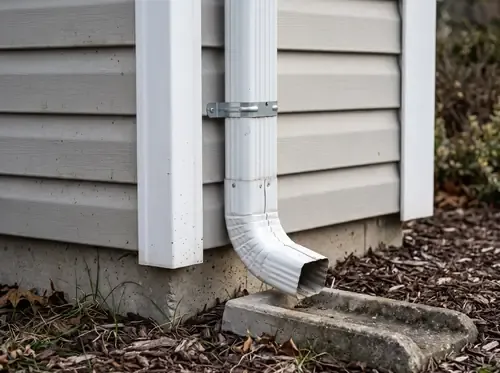
| Splash block | A ribbed pad spreads the stream at the base | Flat yards where water flows away from the house |
| Extension | A length of pipe carries water 4 to 10 feet out | Most houses; can be hinged to flip up for mowing |
| Buried drain line | Solid pipe under the lawn to a pop-up emitter or daylight | Basement houses, lots that slope toward the house, landscaped beds |
| Rain barrel | Stores roof water for gardens | Garden use; needs an overflow |
| Rain garden | A planted hollow that soaks up water | Where the yard has room and the soil allows |
Why does downspout placement matter on Piedmont clay?
The Cecil soils common across the Georgia Piedmont have a red clay subsoil that absorbs water slowly, and building often strips away the topsoil above it. Water that hits bare clay runs across the surface. If the ground slopes toward the house, it runs back to the foundation; if it slopes away, the downspout stream cuts a gully. Basement walls in north Fulton sit in that clay, so a downspout dumping beside the wall can keep the backfill wet for days. See downspout drainage and your foundation.
How are downspouts installed?
- Cut the outlet. The outlet hole goes in the gutter floor and the drop is sealed in.
- Fit the top elbows. Elbows bring the downspout from the gutter back to the wall.
- Run the pipe. Straight sections run down the wall, crimped end into the next piece below so joints shed water.
- Strap it. Straps go at the top, the bottom and every 6 to 10 feet between.
- Turn at the base. A bottom elbow points water away from the house.
- Discharge. An extension, splash block or connection to a buried line finishes the run.
- Test. Water goes through to check the flow and the discharge point.
Do Alpharetta's stormwater rules affect downspouts?
For an ordinary gutter job, usually not. Alpharetta's updated stormwater rules mainly apply when a single-family project adds or replaces 5,000 square feet or more of impervious area. Downspouts should not discharge onto a neighbor's property or straight into a street storm drain with debris; anything other than stormwater entering the system counts as an illicit discharge. Ask a contractor about local rules if you plan major drainage work.
How much do downspouts cost?
They are usually priced per downspout or per foot, with extensions, buried lines and pop-up emitters as extras. National guides group them with gutter installation. Get each item listed in writing.
Downspout terms
| Term | Plain meaning |
|---|---|
| Downspout | The pipe that carries water from the outlet to the ground. Some people call it a leader |
| Outlet | The opening in the gutter floor with a short sleeve that feeds the downspout. Also called a drop |
| Elbow | A bent downspout fitting. A-style turns out from the wall or back to it; B-style turns sideways along it |
| Strap | The metal band that holds a downspout to the siding or brick |
| Splash block | A ribbed concrete or plastic tray under the downspout that breaks the stream before it digs into clay |
| Extension | A length of downspout or flexible pipe added at the foot to carry water farther out |
| Buried drain line | Solid pipe under the lawn taking downspout water to daylight, a pop-up emitter or a street-side outfall |
| Pop-up emitter | A cap at the end of a buried line that lifts under water pressure to let it out onto the lawn |
| Cleanout | A cap or removable fitting where a downspout joins a buried line, so debris can be pulled out |
| Valley diverter | A short metal fin set in the gutter where a roof valley empties, so the rush does not shoot past |