
On this page
- What types of gutter guard are there besides micro-mesh?
- How do screens and perforated covers work?
- How does a reverse-curve hood guard work?
- How are these guards fitted?
- When does a screen or hood make sense around Alpharetta?
- Why do foam and brush inserts disappoint?
- What do these guards cost?
- Can a screen be upgraded later?
- Guard terms
What types of gutter guard are there besides micro-mesh?
| Type | How it works | Pine needles | Heavy rain | Cost |
|---|---|---|---|---|
| Plastic or metal screen | Coarse grid over the gutter | Slide in and stick | Good | Low |
| Perforated aluminum cover | Sheet with rows of holes | Some get in | Good | Low to moderate |
| Reverse-curve hood | Solid cover; water follows the nose into a slot | Can enter the slot | Can overshoot in cloudbursts | Moderate to high |
| Foam insert | Porous foam fills the gutter | Trapped on and in the foam | Fair at first, then poor | Low |
| Brush insert | Bristle cylinder in the gutter | Tangled in bristles | Fair | Low |
How do screens and perforated covers work?
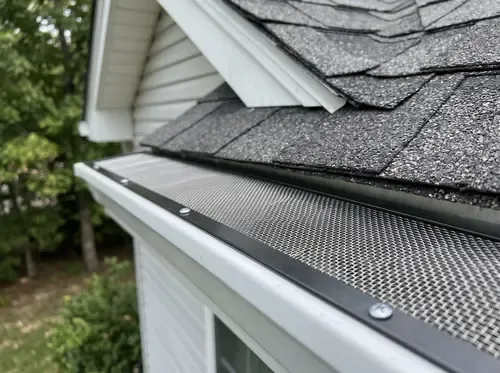
They sit over the gutter and block large debris such as oak leaves and sweetgum balls while letting water through the openings. They work reasonably well under hardwoods. Under pines, needles slide into the openings and lodge, so the screen holds a mat of needles that eventually blocks water.
How does a reverse-curve hood guard work?
A solid cover runs from under the shingles over the gutter, ending in a rounded nose. Water clings to the nose by surface tension and curls around into a slot that leads into the gutter, while leaves slide off the front. In light and moderate rain this works well. In a north Georgia cloudburst, water can move too fast to follow the curve and shoots past. Pine needles can also slip into the slot.
How are these guards fitted?
- Clean the gutter. Every run is emptied and downspouts flushed.
- Repair as needed. Leaks resealed and sags fixed first.
- Fit the guard. Screens snap or screw onto the gutter lip; hoods fix under the shingles and to the gutter.
- Seal the gaps. Joints and corners are fitted to close openings.
- Test. Water is run over the guard to check it enters the gutter.
When does a screen or hood make sense around Alpharetta?
| Situation | Reasonable choice |
|---|---|
| Mostly oaks and maples, few pines | Perforated cover or good metal screen |
| Heavy pine cover | Micro-mesh instead |
| Tight budget, single-storey, easy cleaning | Screen, with regular checks |
| Low-pitch roof, light rain exposure | Reverse-curve hood can work |
| Steep two-storey roof, valleys, heavy storms | Micro-mesh, not a hood |
North Fulton's mix of pines and hardwoods means many homes see both needles and leaves. With about 51 inches of precipitation a year arriving in summer bursts, guards that overshoot or clog are a real problem. See micro-mesh gutter guards and are gutter guards worth it.
Why do foam and brush inserts disappoint?
They hold debris instead of shedding it. Needles and leaf fragments tangle in brushes and settle into foam, and the inserts stay wet, which can grow moss and stain the gutter. Most need removing and cleaning or replacing within a few seasons.
What do these guards cost?
Screens and inserts are the cheapest and are often sold for DIY. Perforated covers cost more. Professionally installed reverse-curve hoods are usually in the higher range. Ask what is included, especially cleaning and repairs before fitting.
Can a screen be upgraded later?
Yes. Many homeowners start with screens and switch to micro-mesh after a season or two of pulling needles out of them. The gutter usually needs a full clean and a check of joints and hangers before the new guard goes on.
Guard terms
| Term | Plain meaning |
|---|---|
| Reverse curve | A solid hood guard. Water follows its curved nose and drops through a slot behind it |
| Perforated cover | A guard of aluminum or vinyl sheet punched with holes |
| Micro-mesh | A guard with a very fine stainless steel mesh stretched over an aluminum frame |
| Drip edge | Bent metal trim along the roof edge, tucked under the bottom shingles, that steers runoff into the trough instead of onto the board |
| Pine straw | Fallen loblolly and shortleaf pine needles, used as mulch here and a constant gutter filler |
| Outlet | The opening in the gutter floor with a short sleeve that feeds the downspout. Also called a drop |
| Fall | The pitch of a run toward its outlet, usually about a quarter inch for every ten feet |